

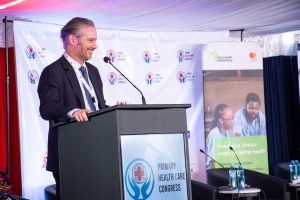
The final day of the 2nd Primary Health Care Congress brought together policymakers, researchers, development partners, and academic leaders to examine how technology, innovation, and collaborative leadership can accelerate Primary Health Care reforms across Africa.
Discussions throughout the day explored how digital health, artificial intelligence, climate-resilient health systems, and workforce development can strengthen health systems and improve access to care, particularly at the community level.
The sessions also highlighted the importance of African-led solutions and partnerships in building resilient health systems capable of responding to global uncertainties.
Technology Transforming Primary Health Care Delivery
A key focus of the day was the growing role of digital technologies in improving Primary Health Care delivery.
In one of the plenary sessions, speakers demonstrated how digital health platforms and telemedicine are helping decentralize care and improve decision-making in health systems. A case study from Murang’a County in Kenya as presented by Governor, Murang’a County, Hon. Irungu Kang’ata showed how integrated digital systems are enabling real-time data tracking across health facilities, strengthening procurement systems, and improving workforce accountability.
The system allows health leaders to monitor disease trends, patient volumes, and service delivery performance, enabling more evidence-based decisions in resource allocation and service planning.
Participants emphasized that while technology presents significant opportunities, digital solutions must remain people-centered and designed to address real health system challenges rather than simply digitizing existing inefficiencies.
Artificial Intelligence and the Future of Community Health
Another major discussion focused on the emerging role of artificial intelligence in strengthening community health systems.
Kenya’s digital community health infrastructure was highlighted as an important foundation for scaling AI-driven solutions. With thousands of digitized facilities and community health workers using digital tools, the country has created a strong data ecosystem that can support predictive analytics, disease surveillance, and improved service delivery.
Experts noted that artificial intelligence has the potential to support clinical decision-making, automate reporting, and help frontline health workers prioritize care for vulnerable populations.
However, speakers emphasized that scaling AI requires strong data governance, infrastructure investments, and a skilled workforce to ensure responsible and ethical use of emerging technologies.
Strengthening Health Workforce Capacity and Leadership
Day Three also explored the role of universities and training institutions in preparing the next generation of health leaders.
Participants discussed how postgraduate education programs must evolve beyond producing graduates to developing systems thinkers capable of addressing complex public health challenges. Universities were encouraged to strengthen partnerships with governments and health institutions to ensure that research and training programs respond to real health system needs.
Speakers also highlighted the importance of experiential learning, international collaboration, and integrating digital technologies into public health training programs.

Climate Change and Global Health Security
Another session examined how climate change is reshaping global health security and increasing the urgency of strengthening disease surveillance and preparedness systems.
Presentations highlighted how climate-driven events such as floods, changing ecosystems, and food insecurity are contributing to emerging disease threats and placing additional pressure on already fragile health systems.
Participants emphasized that strengthening surveillance systems, integrating One Health approaches, and improving coordination between sectors such as agriculture, environment, and health will be critical to building resilient health systems.
Rethinking PHC Delivery Through the PHC Accelerator Bundle
A dedicated session introduced the PHC Accelerator Bundle, an integrated framework designed to strengthen Primary Health Care systems through three interconnected pillars: community financing, data-driven decision-making, and leadership development.
The model encourages countries to move beyond incremental reforms and instead adopt structural approaches that empower communities as active producers of health while strengthening accountability and data use within health systems.
Countries were invited to pilot the accelerator model and join a learning network that will support collaboration, peer learning, and evidence generation across the region.
Closing the Congress with a Call to Action
The congress concluded with a closing ceremony that synthesized three days of dialogue and reaffirmed Primary Health Care as the foundation for Universal Health Coverage and health security across Africa.
Participants called for stronger domestic financing for health systems, including commitments to allocate at least 15 percent of national budgets to the health sector. Leaders also emphasized the need for continued investment in digital health systems, workforce development, and community engagement to ensure that Primary Health Care remains responsive to the evolving health needs of African populations.
The closing session also announced the establishment of a continuing forum to sustain collaboration among governments, universities, and development partners working to strengthen Primary Health Care systems across the continent.
As the congress came to a close, participants reaffirmed a shared commitment to building resilient, equitable, and community-centered health systems capable of advancing Universal Health Coverage and improving health outcomes across Africa.