

Rethinking Health Research Through Systems Thinking: The AMIU/–HSS-MEAL Collaboration Model
In today’s rapidly evolving landscape of global health, there is a growing recognition that linear, isolated interventions are no longer sufficient to address the complex, interconnected challenges that health systems face. This reality demands a new paradigm: systems thinking in health research. It’s an approach that acknowledges the complexity of health systems and seeks solutions by understanding the relationships between their parts. In this spirit, the AMIU–/HSS-MEL Research Collaboration championed by Amref Health Africa stands out as a pioneering initiative built not only on generating evidence but on redesigning how that evidence is created, interpreted, and used to transform health systems from the ground up.
At its core, the collaboration embraces a systems lens by placing equal emphasis on relationships, feedback loops, and co-creation. The initiative operates under the theme: “Partnership for Collaboration & Co-Creation of Evidence to Strengthen Outcomes & Policy Translation.” This is not a catchphrase, —it is a working model. Rather than producing isolated research outputs, the collaboration brings together a diverse ecosystem of stakeholders: AMIU postgraduate students and faculty, ministries of health, civil society organizations, community actors and Amref’s country offices, MEL teams, and the Amref’s HQ-HSS departmentdirectorate. The co-creation model ensures that each stakeholder plays a distinct but interdependent role turning them into joint architects of research design, implementation, and knowledge generation and translation. The university postgraduate students and faculty ensures that fresh perspectives are combined with academic rigor, while the involvement of CSOs and implementing partners guarantees that the research agenda is grounded in lived realities and pressing local challenges. This continuous dialogue between stakeholders embeds local contextualization and priming into every phase, ensuring that the evidence generated is not only academically rigorous but operationally relevant, —a key principle of systems-informed inquiry. This co-creation also fosters adaptability: as new system behaviors emerge, the research agenda can pivot, preventing costly detours and reinforcing the system’s capacity for learning. legitimacy, and impact.
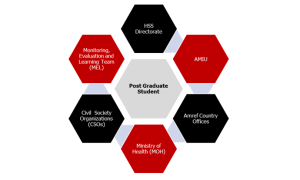
Fig. 1: The ecosystem of partners
A major strength of systems thinking is that it resists the urge to simplify. The AMIU/HSS initiative reflects this by addressing learning questions drawn from the lived experiences of communities and that span multiple facets of the health system, including Primary Health Care, RMNCAH (Reproductive, Maternal, Neonatal, Child and Adolescent Health), neglected tropical diseases, food systems, health governance and information systems, and human resources for health. This multidisciplinary, multi-thematic structure recognizes that improvements in one domain are inherently linked to others therefore, each learning question becomes a micro-simulation of broader system dynamics, ensuring findings capture both intended and unintended consequences.
Through this approach, the initiative also builds institutional and human capacity across the system. Faculty and supervisors are equipped to mentor with a systems lens, students are trained not just in methodology but in complexity, interdependence, and stakeholder engagement, policy actors and implementing partners learn how to integrate evidence into decision-making frameworks, and for the broader health research ecosystem, it sets a precedent for how academic institutions can move beyond ivory towers to become integral drivers of system transformation. Each part of the system is strengthened in relation to the others, creating resilience that extends beyond the life of the initiative.
Leadership development is also a key outcome of this initiative. By immersing students in systems mapping exercises, causal loop diagramming, and scenario planning, the program cultivates a new cadre of health professionals equipped to navigate complexity. These emerging leaders learn to ask the “why” behind the “what,” to trace the upstream drivers of downstream health outcomes, and to spotlight emergent behaviors that static models would overlook. Such capacity building generates a ripple effect: as alumni integrate systems approaches into their future roles, —whether in government ministries, NGOs, or academia, —they diffuse a mindset of holistic inquiry.
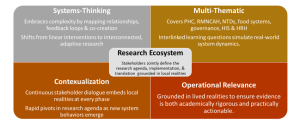
Fig. 2: The AMIU-HSS -MEL Collaboration Model
Ultimately, the AMIU–/HSS-MEAL Research Collaboration is a bold demonstration of how systems thinking can be operationalized in health research. It challenges the traditional boundaries between academia and practice, between research and policy, and between knowledge and action. It affirms that health systems are complex, but not unknowable; and that with the right approach, —grounded in collaboration, co-creation, and systems thinking, —we can generate evidence that not only informs but transforms. In doing so, the initiative positions itself at the cutting edge of health systems research. It is not simply about what we study, —it is about how we study it, with whom, and to what end. The AMIU–/HSS-MEAL Research Collaboration reminds us that in a complex world, the most powerful answers come not from isolated findings, but from connected minds working within a connected system.
By
David Olpengs and Dr. Jennifer Mamwa
Health Systems Strengthening department, Amref HQ